Pages

Showing posts with label Japanese woodblock. Show all posts

Friday, 5 August 2022

Waste not . . .


cards and offcuts from trial prints of Fence Cross Lane
© Teresa Newham

Every printmaker has spare prints which didn't make it into the edition for some reason.  I decided to turn some of mine into greetings cards. I took trial prints of my reduction linocut Fence, Cross Lane, cut out squares of the most interesting parts of the design and stuck them onto cream card blanks. The offcuts have potential too.


my first experiments with Japanese Woodblock put to good use
© Teresa Newham

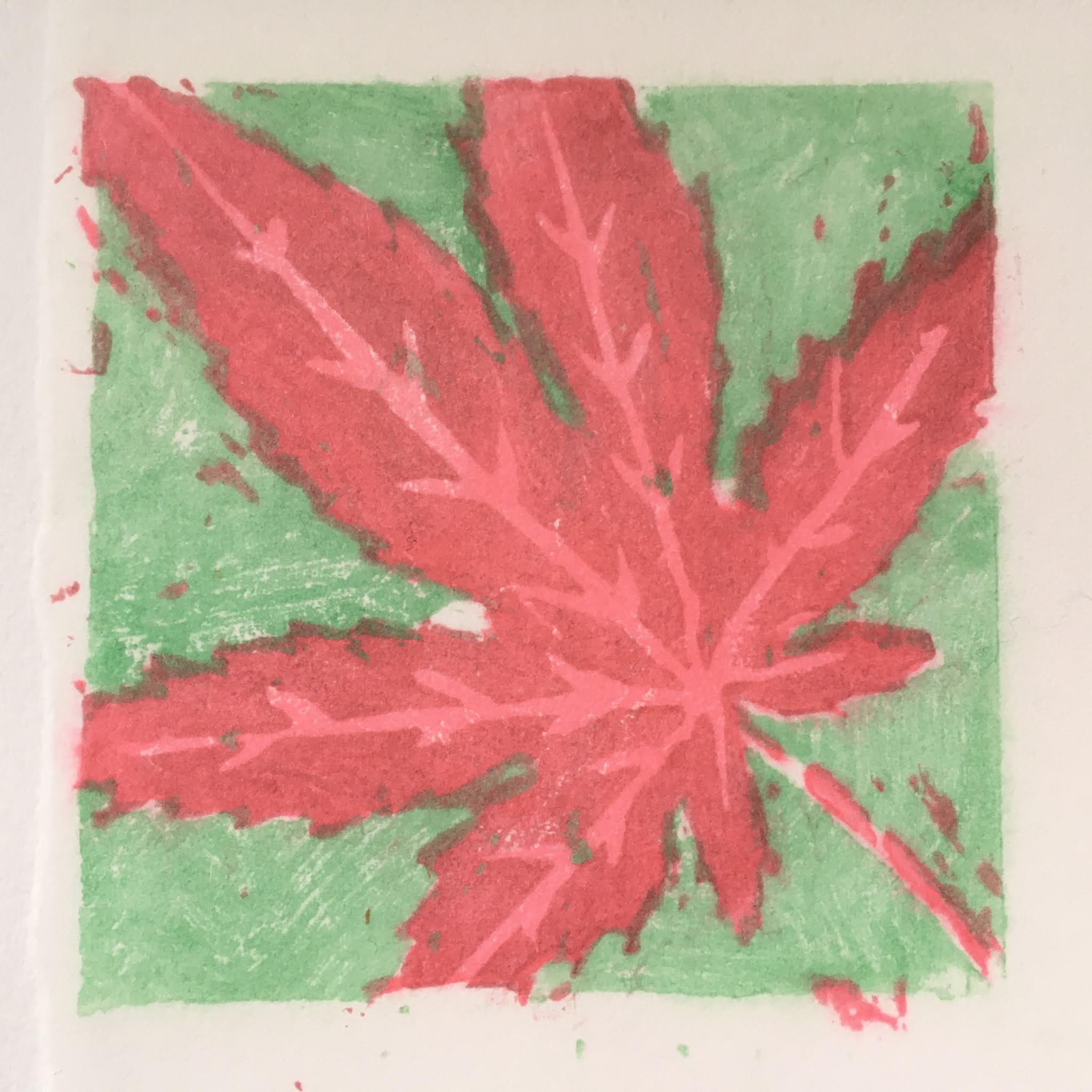
The best of my first ever Japanese Woodblock print, an Acer Leaf design, are just the right size for cards, and make good use of something which was essentially an experiment with a technqiue brand new to me.  


revisiting the rainbow-rolled New Covenant
© Teresa Newham

I sold the last two cards of an older design, The New Covenant, at Art on the Common. I've printed more onto pre-cut squares of washi, along with some extras of the Sunflower for Ukraine card design. This gives a better result than printing directly onto the card blanks.


New Covenant and Sunflower for Ukraine card fronts drying
© Teresa Newham

I've also revamped an old linocut print of mine, Meadow Cranesbill, for which I  made a lot of impressions.  Some of these have become cards, this time on white blanks.  I can't tell in advance whether I should use white or cream blanks for the cards, I have to decide on the day and go with my instinct.


an old favourite trimmed down for cards
© Teresa Newham

White card blanks also seemed to go better with the snow on the cards I made from my trial prints of Redwings in the Holly.  It's so much better to use these for cards rather than throw them away, and it's something a little different to offer to our #HertsOpenStudios visitors in September!


trial prints of Redwings in the Holly turned into cards
© Teresa Newham


Wednesday, 20 July 2022

Mokuhanga mayhem


Skelligs Setting Sun
original Japanese Woodblock print
by Teresa Newham

 I've been continuing my exploration of Japanese Woodblock (mokuhanga), using the design for my Skelligs Golden Light linocut.  I reduced the size of the image to fit the blocks for this multi block process and cut four of them. I also cut the registration marks (kentou) with a chisel for the first time, and hoped they would fit.


adapting and cutting the design, including the kentou
© Teresa Newham


The trial prints on proof paper got me back into the swing of things, but I didn't like any of the colours, the birds didn't work and the blocks needed some tidying.  The registration on one of the blocks was slightly out but I was confident that I could correct that during printing, as long as I remembered . . . 


early colour trials
© Teresa Newham

The materials and method for Japanese woodblock are quite unlike anything else I have done, and even just thinking about how I might move forward with the design was useful.  The blocks can be used again and again with different colour combinations - the possibilities are endless.


studio set-up for Japanese Woodblock 
© Teresa Newham


I was far happier with my next attempt, and progressed to making prints on Shiramine Japanese washi paper from the Awagami Factory in Japan.  The paper was probably a little too wet, as the prints were softer than I'd intended, but as I was after a misty effect that didn't matter too much.


Skelligs Misty Blue
original Japanese Woodblock print
by Teresa Newham

I decided to make another version using just three of the blocks, and did two more colour trials.  One was a sunset based on one of my photos, and the other a more stormy scene reminiscent of my earlier linocut.  I preferred the sunset but when I posted the proof prints on social media my followers chose the storm as their favourite!


baren, inking brushes and colour mixes
© Teresa Newham


What else could I do but print them both? I managed this in the same print session, which was a challenge but also great fun.  Skelligs Stormy Skies is below, and Skelligs Setting Sun is at the top of this post.  Which one do you like the best?


Skelligs Stormy Skies
original Japanese Woodblock print
by Teresa Newham


Friday, 15 October 2021

Learning as I go


Japanese woodblock print of acer leaf on Shiramine Select
by Teresa Newham

Was it a good idea, I wondered, to demonstrate Japanese woodblock printing during #HertsOpenStudios?  I'm still learning the technique and hadn't done any for ages, but what better way of getting to grips with it again?  I could set up outside - ideal for the Covid-secure experience we were trying to create - and the weather, for the first few sessions at least, was forecast to be fine and dry.


setting up the demo table outside
© Teresa Newham

Working outdoors presented the usual challenges; any items likely to blow away in the wind (virtually everything on the table) had to be weighted down.  I began to print proof copies to remind myself what I was supposed to do.  This took longer than one session, which forced me to reduce the size of the damp pack to fit it into the freezer until the next time, when I defrosted and completed the proof prints. It was so absorbing that I forgot to take any more photos.


printing the blue plate
© Teresa Newham

Oh, the joy of doing this outside! I was able wet the blocks and shake the excess water straight onto the patio; neither the prints nor the damp pack dried out too quickly; it was the perfect environment.  In fact I had to take care not to get everything too wet.  By the third session I was confident enough to try printing on two types of Japanese washi from the Awagami factory.


printing the yellow plate
© Teresa Newham

Keeping things as simple as possible, I only made four prints, which would fit easily into a small damp pack (in case it had to go into the freezer again). The beauty of Japanese woodblock is that you can re-use the blocks to make more prints, even years later.  I remembered not to use too much paint and nori and tried to describe the process to our visitors, who were completely fascinated by it.


trying out bokashi shading technique
© Teresa Newham

I then had a go at doing some bokashi shading, which was a little fiddly for a beginner like me, but produced some interesting effects.  It would probably have worked better on a larger piece - so I'm thinking of going larger next time.  


finished prints in the damp pack
© Teresa Newham


I dried the prints between layers of thick blotting paper under heavy books as usual, and moved indoors to demonstrate different techniques as the weather deteriorated for our final few days.  When I went back to the prints I found that the Shiramine Select had produced the best result, which is just as well; I have a stash of it in my studio waiting for the next print . . . 


Japanese woodblock print of Acer leaf on Okawara Select
© Teresa Newham


I'll be demonstrating what I've learned so far about Japanese woodblock on Friday 22nd October at The Workhouse Dunstable, 5 Ashton Gate LU6 3SN  from 10am - 12.30pm, so do come and take a look!


Thursday, 30 September 2021

Fine and dandy


plenty to see in my studio . . .
© Teresa Newham

#HertsOpenStudios is well under way!  Sue and I have been welcoming people twice a week since 18th September, with two more Saturdays and the Wednesday in between still to go.  We've had a pleasing number of visitors and excellent weather so far.


. . . making use of all available space 
© Teresa Newham

The weather has been extremely important this year, as we are keeping everything as ventilated as possible, and sitting outside when we can, in order to give folk more space to browse. My own studio behind the kitchen is their first stop, where they can see most of the watercolours and reduction linocuts that I have made over the past two years.


Sue's display on my dresser, and her display board & browser
© Teresa Newham


Sue's work is laid out in my dining room as usual - a mixture of watercolours and drawings, and her lovely painted hearts.  Like me, she has made good use of her time during lockdown - but we are both absolutely delighted to be meeting people face to face again, some for the first time in ages.


more of Sue's work in my dining room
© Teresa Newham


I have some pieces in the dining room too, along with greetings cards.   Having kept so much of my work to myself for so long (showing it on social media isn't quite the same) I am loving the feedback, the comments, the insights and the interaction which Open Studios brings with it.


my dining room display
© Teresa Newham

We've both made some sales, and I've had the chance to try out my SumUp card machine for the first time - it works really well.  We still accept cash, of course, but it's good to give people the option because we want everyone to feel comfortable when they come and see us.


sketchbooks laid out on the dinner table - for now!
© Teresa Newham


Our demos have been taking place outside while the weather has lasted - although for the last three sessions we'll almost certainly be indoors. The watercolours Sue makes during Open Studios often become exhibits the following year. I've been printing Japanese Woodblock - but that will have to wait for another blog post!


Sue painting in the garden - well wrapped up
© Teresa Newham


Sue and I will be open again from 11am - 4pm this Saturday 2nd October, Wednesday 6th October and Saturday 9th October.  For full details of venue including directions of how to find us, click here.


Saturday, 13 February 2021

Learning to love Japanese woodblock


my second Japanese woodblock print
© Teresa Newham

I recently had another Japanese woodblock print session, after tidying up the original blocks from the first one.  They'd scrubbed up well, but it was obvious when I looked at the registration prints from my original attempt that I needed to clear away some more.


evaluating the blocks after the first print session
© Teresa Newham

That done, it was time to prepare the damp pack. Luckily I had plenty of notes to check in case I'd forgotten something vital  -  whichI did several times throughout the whole process, because the Japanese woodblock technique isn't second nature to me yet . . .


preparing a damp pack
© Teresa Newham

I used gouache as the print medium. Even while I was making trash prints and taking impressions on newsprint to check the colours and the registration, I could see that the colours were truer than I'd achieved with watercolour.


the colours were definitely truer with gouache
© Teresa Newham

Despite my best efforts, I still managed to over-ink the blocks - although I did use less ink than previously.  I'm too keen to get results straight away, and will have to get used to the idea that bright colours are best achieved by printing one layer a couple of times.


printing the various layers
© Teresa Newham

Finally I had six prints on three different washi papers. To dry, they go between sheets of clean newsprint for an hour under a light weight, and then under a pile of books for a few days, layered between sheets of blotting paper, which is changed daily.


placing the prints between layers of clean newsprint
© Teresa Newham

It's true - everything about this process is a faff, but I shall do more. At the moment, however, I have lots of ideas for linocuts, too, so I will set Japanese Woodblock aside for a while. Just as well I made those notes!


the finished prints on three different types of washi paper
© Teresa Newham


Saturday, 30 January 2021

New Year, new technique


my first ever Japanese woodblock print
- scope for plenty of improvement!
© Teresa Newham


As usual, Christmas took up most of my attention during December; so it was good to set aside a couple of afternoons in early January to finish cutting the blocks for my first ever Japanese woodblock print, listening to various podcasts and jotting down a few notes as I went along. 


a cosy afternoon cutting the rest of the blocks
© Teresa Newham


The thought of actually printing the blocks, however, was completely out of my comfort zone. I re-visited Laura Boswell's book and YouTube videos on the process, and carefully laid out everything I thought I'd need in what I told myself was a suitably Zen state of mind, but really it was displacement activity.


gathering everything I needed to print
© Teresa Newham


I made up a damp pack the evening beforehand;  the proofing and editioning papers are wetted with a water brush and left in damp newspaper or blotting paper overnight to absorb the right amount of moisture. Usually proofing and editioning are done in separate print sessions, but as this was an experiment I was keen to go through the whole process in one go.


first steps: mixing nori, watercolours and making trash prints
© Teresa Newham


On the big day I mixed up some watercolours in pots, and diluted some ready-made nori (rice flour paste), which is combined with the watercolour on the block to turn the paint into a print medium. I used Quinacridone Red and Cobalt Green (Yellow shade), and made a second, darker quantity of the red by adding a tiny amount of Sumi ink.


colourful blocks and a trash print to check registration
© Teresa Newham


I wetted each block  and brushed in some nori to condition it, before inking it and taking trash prints on dry scrap paper. I checked the registration by taking an impression on dry newsprint.  At this point I could have cut away some of the chatter from the blocks and adjusted the colours, but I wanted to move on to the editioning stage so I could compare results on the various washi papers.


printing proof prints and edition prints
- the damp pack is inside the John Lewis bag
© Teresa Newham


The prints dried between sheets of blotting paper under a weight for a few days before I assessed them. I'd forgotten Laura's advice that in Japanese Woodblock, less is more; I'd used too much nori and ink, which has affected the colours and - along with the chatter - made the prints messy.  But that's the thing with multi block printing - I can clear out that chatter and have another go!


final prints on three different washi papers from the Awagami factory
© Teresa Newham


Saturday, 31 October 2020

Mood Indigo


linocut Christmas cards in indigo on white
© Teresa Newham

It's a reflective time of year, as the clocks go back and the nights draw in.  Less daylight means shorter studio sessions; and as I'm trying something new I've taken plenty of time when considering how to go about things. I made several attempts to turn a sketch of an acer leaf into a design for a Japanese woodblock print, and was delighted when I finally hit upon something I was happy with.


evolution of a design
© Teresa Newham


 At the same time, I've been selling Christmas cards in aid of the church building fund: unable to do this after Mass, as I normally would, I sent out an email and was delighted by the response.  Someone asked if I'd print the design in indigo on white card, and it was interesting to see the result; I think they look rather smart.  


mixing the right colour
© Teresa Newham

My next Japanese Woodblock challenge was to work out how to transfer the image for cutting - at which point I realised that while my lovely design fitted onto the block, there wouldn't be enough room to cut the kento registration marks without running the risk of splitting the wood.  And there would be no margin down one side. That led to quite a bit more careful contemplation . . .


looking at various options
© Teresa Newham

One end of the studio was full of drying cards; at the other end of the table my sketchbook lay open reproachfully as I tried to work out a solution to the problem.  I considered buying bigger blocks, or printing the leaf anyway, regardless of the margins.  Then I realised that with a bit of careful positioning I could use some stick-on kentos for this first attempt, as they take up less space.


the drying end of the studio
© Teresa Newham

My notebook is now full of reminders and suggestions for various blocks and colourways, but at least I have what I hope is a workable plan.  So it's been a busy time in the studio; I think I've managed to avoid falling at the first hurdle as far as Japanese Woodblock is concerned, but we'll see.  You have to start somewhere!


the way forward
© Teresa Newham